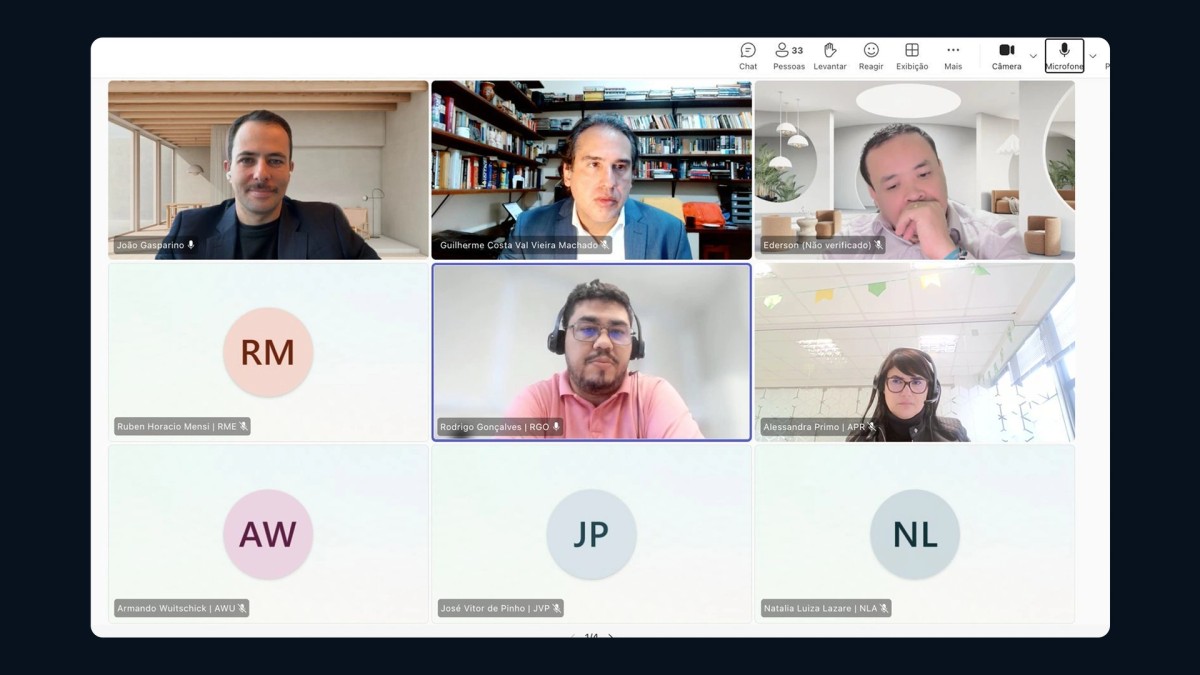
Last week we took a Consumption Tax Reform workshop to the team at Araxá Engenharia, in partnership with Ballstaedt Gasparino Advogados. The brief was clear: less overview, more diagnosis. What mattered was how IBS (Tax on Goods and Services) and CBS (Contribution on Goods and Services) affect the margin, the cash and the contracts of an engineering company — a house that has been designing infrastructure, energy and environmental projects for more than 14 years. Our thanks to Alessandra Primo for her trust and her partnership.
We came away with four points. They hold for anyone who buys a lot, delivers projects and signs long contracts.
Procurement stops being a quotation desk
On a construction site, much of the cost comes in through purchasing: equipment, materials, rentals, subcontractors. Under IBS and CBS, the tax carried down that chain is the raw material of the company's credit, and that credit depends on what the transaction and the contract document. Supplier management therefore becomes a margin decision: two bids at the same price reach the cash in very different ways.
Engineering's 30% is real, partial and conditional
Article 127 of Complementary Law 214/2025 cuts the IBS and CBS rates by 30% on services provided by 18 professional categories whose intellectual work is subject to a professional council. Engineers and agronomists are on the list, under item XI. Good news, with three caveats:
- It is a rate cut, not an exemption: 70% of the tax remains.
- It reaches the intellectual service, not the supply of goods and materials, nor the construction package sold as a block. Without segregating the deliverables, the benefit is lost inside the contract.
- For a legal entity, the requirements in § 1, II are cumulative: partners licensed and tied to the corporate purpose, no legal entity among the partners, the company holding no stake in another company, and the core activity performed by the partners themselves.
A holding company among the partners knocks the right down, even if the business is engineering from the front door out. An equity stake at the other end — a project SPE (special-purpose entity), for instance — has the same effect. This is a point of structure, not of rate.
What shrinks in the transition: ICMS and Padis
Between 2029 and 2032, article 128 of the ADCT (the transitional provisions of Brazil's Constitution) reduces the rates of ICMS (the state tax being phased out) and ISS (the municipal services tax being phased out) to 9/10, 8/10, 7/10 and 6/10 of the rates in force, until both are extinguished in 2033. Paragraph 1 requires ICMS benefits to be cut in the same proportion: it is not the state's choice, it comes as a knock-on. Because ICMS is calculated inside its own base, the effective loss tends to be greater than the nominal fraction. This is a case for simulating, not estimating.
There is one door: the Tax Benefit Compensation Fund (articles 384 to 405 of Complementary Law 214/2025) compensates, from 2029 to 2032, holders of onerous benefits — granted for a fixed term and subject to conditions — registered by 31 May 2023, with their counterparts fulfilled. Qualification must be applied for by 31 December 2028, and the window is already open.
On the federal side, the alert is Padis (Brazil's incentive program for the semiconductor industry): Complementary Law 214/2025 revoked, with effect from 2027, the program's core relief from PIS/Cofins (the federal contributions on revenue), CIDE and Import Tax (items I and II and §§ 2, 3 and 5 of article 3 of Law 11.484/2007). It does not end all at once, but anyone buying semiconductor or photovoltaic-chain equipment redoes the cost calculation.
Reidi and Rehidro do relieve the burden, if well run
Reidi (Brazil's special regime for infrastructure projects, Law 11.488/2007) today suspends PIS/Cofins on purchases of new machinery, equipment and materials for infrastructure works. Articles 106 and 107 of Complementary Law 214/2025 swap that suspension for one on IBS and CBS, extend the benefit to services and to equipment rental, convert the suspension into a zero rate when the asset goes into the works, and charge the tax with a fine if it does not. The benefit runs for up to five years from qualification. Reidi does not die: it migrates. And it remains a benefit of the qualified project, not of the company.
Rehidro (Brazil's special regime for low-carbon hydrogen, Law 14.948/2024) has a similar design for low-emission hydrogen projects: it suspends PIS/Cofins for five years from 2025, with qualification tied to regulation and local content. Its fit into IBS and CBS, however, still has no provision equivalent to Reidi's. It is a point to watch, especially for co-qualified companies along the chain.
The transition runs to 2033, and it is easy to read that as a deadline. It is not. A contract signed today crosses the change, a corporate structure does not change in three months, qualification has a window with a date on it. Anyone who wants to protect margin simulates now, transaction by transaction, and decides with the numbers in hand. The Consumption Tax Reform is not a subject for 2027, let alone for 2033. It is a 2026 decision.
This content is for information purposes only and does not replace a technical analysis of your company's specific situation.